B.C.’s ‘Incredible Crossings’ celebrated in a new book
Posted December 11, 2022 3:40 pm.
Last Updated January 13, 2023 12:57 pm.
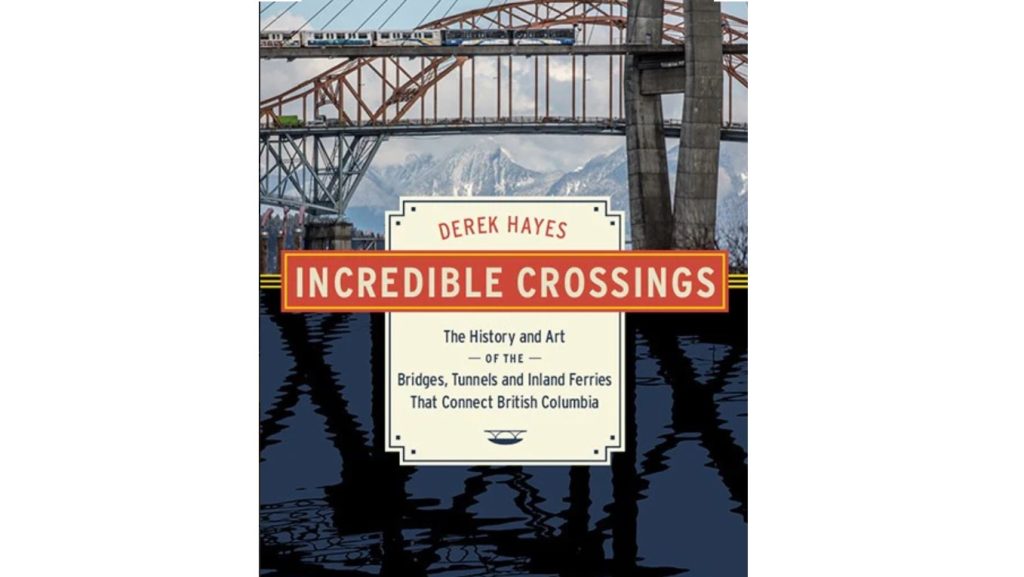
We use these structures every day – the Arthur Laing, the Alex Fraser, and the Lions Gate — but how much thought do we really give them and how they came to be? And would we consider them art? These are some of the questions tackled in the new book Incredible Crossings: The History and Art of the Bridges, Tunnels, and Inland Ferries That Connect British Columbia by author and historian Derek Hayes.
He admits it began as something of a COVID project. Hayes was working on a completely different book when the world shut down in March 2020 and scuttled his plans to travel to Japan and research high-speed rail.
“I was looking for something that I could do without leaving British Columbia basically,” he admits. “And I already had a huge collection of bridges — old bridges, and new bridges, and stuff — because, as a photographer, I’ve always been fascinated by the curves and the lines and general geometric patterns of bridges. So, I decided that I could add to that and add the history. And so, I took off on a couple of tours around B.C., which of course was the only place you could go into 2020 anyway, and lo and behold that ended up as a book.”
This week on the #CityNewsBookshelf on @CityNewsVAN — author and historian Derek Hayes talks about "Incredible Crossings: The History and Art of the Bridges, Tunnels, and Inland Ferries That Connect British Columbia," new from @Harbour_Publish. pic.twitter.com/tyvcZvKTru
— John Ackermann ???? (@jackermann) December 11, 2022
Hayes figures there are about 3,500 bridges, both road and rail, in B.C. But instead of including them all, he focused on the ones he personally found interesting.
“One of the reasons I had for doing this was to try and document some of the bridges that are disappearing, you know, like, wooden truss bridges all over the province, for example, that are quite scenic,” he explains.
“And anything that I know is going to change, I tried to photograph it so that I’ve got a record on it. So that’s what I was doing here.”
Read More: Building the ‘Iron Road West’ that forged modern British Columbia
However, current events, as they have a way of doing, influenced how the book turned out. For instance, Hayes spends some time addressing the atmospheric rivers of 2021 that took out bridges along the Coquihalla Highway.
“I actually had to sort of almost rewrite a bit of the end of the book to cover all that because it was something I hadn’t thought I’d have to deal with, shall we say.”
Hayes argues we take much of our infrastructure for granted, pointing to a recent snowfall event on the Lower Mainland.
“Well, I mean, bridges are what they call critical infrastructure, right? What happened on the Alex Fraser Bridge the other night is a case in point, you know. [When] you cut off these choke points, they are going to have a very great effect on everybody. And, of course, the Lower Mainland is just like a lot of B.C., it’s got so many rivers and water bodies that need to be crossed one way or the other.”
Read More: Snow causes havoc on Lower Mainland highways for Wednesday commute
One of the hallmarks of the book is the meticulous research behind it, leading to the individual stories behind many of these structures. Hayes injects a fair bit of humour into the book too, like how the City of Richmond surely could have found a better name for its No. 2 Road Bridge. Having grown up in Richmond myself, I pointed out to him that the name actually came from a contest.
“Yes, that’s true,” he says. “But it’s rather sad, isn’t it, that something like ‘number two’ wins a competition!”
Ultimately, he hopes the reader comes away with a deeper appreciation and enjoyment of these incredible crossings.
“I think people like to find out how things were and how things got to be the way they are today. I certainly do and I have fun trying to track down the history of things that I don’t know, why they’re there or how they’re there or why they’re there in that form or whatever. So, you know, that’s the whole point is just enjoyment.”
Incredible Crossings: The History and Art of the Bridges, Tunnels, and Inland Ferries That Connect British Columbia is available from Harbour Publishing.