‘Nothing is really going to change,’ NHL Deputy Commissioner says on Pride tape ban
Posted October 10, 2023 11:58 am.
Last Updated October 10, 2023 4:40 pm.
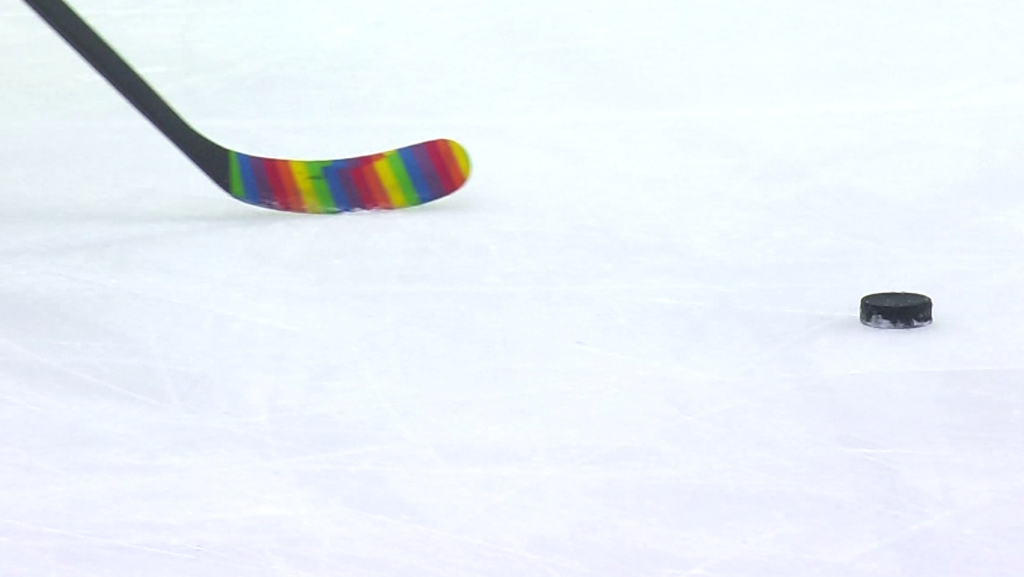
The NHL is explaining why it’s decided to ban players from using rainbow-coloured Pride tape hockey sticks this year.
Last week, the league sent a memo to teams clarifying what players can and cannot do as part of theme celebrations this season, which included a ban on the rainbow tape.
Deputy Commissioner Bill Daly says despite the new rule, he still expects teams to celebrate certain theme nights.
“Nothing is really going to change in the sense that our clubs will continue to celebrate these special initiatives and these causes and do a lot of cause-messaging around these events,” he told Sportsnet 650 on Tuesday.
“The only difference this year is we’re asking the clubs not to employ use of the players on the ice during the game.”

Bill Daly speaks to the media. (Martti Kainulainen/Lehtikuva via AP)
Last season, the NHL had decided not to allow teams to wear any theme jerseys for warm-ups after a handful of players opted out last season.
Several Russian players decided against wearing the Pride night warm-up jersey as Russian anti-gay laws escalated.
Russian players, including Buffalo Sabres defenseman Ilya Lyubushkin, did not wear the jersey. Columbus Blue Jackets defenseman Ivan Provorov, then on the Philadelphia Flyers, sat out of warm-ups entirely. Some teams, like the St. Louis Blues, Chicago Blackhawks, New York Rangers, and Minnesota Wild, scrapped the warm-up sweaters altogether.
A handful of Canadian players, including Marc and Eric Staal and James Reimer also refused to wear the Pride jerseys citing their faith as the reason why.
Related Stories:
-
NHL’s Pride nights collide with LGBTQ+ political climate
-
Vancouver Canucks to wear Pride jerseys
-
Vancouver Canucks’ Andrei Kuzmenko won’t wear Pride jersey: coach
Daly says the aim of the new memo is to avoid making some players uncomfortable.
“We had some issues last year with players feeling uncomfortable and supporting certain causes and we didn’t want our players to be put in that position moving forward,” he said.
“We don’t want the situation where some players, or a large majority of players, use a certain cause messaging that other players don’t want to utilize, and that puts other players in a difficult position.”
However, the executive adds players are still allowed to show support for certain causes, just outside of game scenarios.
“Players are encouraged as they always have been to show support for causes and fight for causes they feel strongly about,” he said, adding he expects clubs to invest even further in certain theme nights, just without involving the players.
The Vancouver Pride Society has responded to the tape ban, expressing “disappointment” in the league’s decision.
“Sports have historically been a challenging environment for the 2SLGBTQIA+ community, and public gestures of support like Pride Tape play a role in creating a welcoming atmosphere. These symbols have carried significant weight in making hockey more diverse and inclusive,” the society said in a statement to CityNews.
“The removal of Pride Tape goes against the NHL’s statement of commitment to inclusion, diversity, safety and respect, as it sends a disheartening message to 2SLGBTQ+ fans and aspiring athletes seeking acceptance in the sport.”
Pride tape ban a blow to 2SLGBTQIA+ visibility, advocate says
An organization that aims to reduce homophobia in sports says the NHL ban on Pride tape overshadows positive steps taken to make hockey more inclusive.
Kurt Weaver, COO of the You Can Play project, tells CityNews it’s important to have the colourful visibility on the game’s biggest stages.
“It’s the biggest visibility point we have, which is the on-ice product. Even though visits to the community centre were happening, and money’s been raised and given to local community organizations and lots of other great work, the big visibility comes during the broadcast during the game, during what’s happening on ice,” he said.
“It makes people wonder ‘is this sport for me?’ because the actual product where it matters is the time that we’re not seeing that visibility happen.”
You Can Play speaks on the NHL’s decision to disallow pride symbols of any kind, including Pride jerseys and Pride tape on the ice for warm ups and games. pic.twitter.com/CobD5TSEnK
— You Can Play (@YouCanPlayTeam) October 10, 2023
Weaver says the move may make it more difficult to entice members of marginalized communities to take up the sport.
“Those who were looking and wondering if this sport was for them, they no longer see that visual. So it’s going to take extra convincing, and extra work, and extra outreach to the community so they understand that the sport is for them,” he said.
The ban on the Pride tape, Weavera adds, is a short-sighted move to address concerns from a small minority of players.
“For shorter-term thinkers, ‘remove the problem’ becomes the easiest solution in many cases. And I think that’s what you’re seeing, not just in hockey, I think you’re seeing it in many aspects of life,” he explained.
“People ask us the question all the time: ‘why do we specially need to go out and invite a certain group to hockey, or to any sport?’ And the answer is because traditionally, it’s not really been for that group. So in that case, you really have to go out and give a special invitation.”
Weaver says the organization will continue working with the league to come up with new ways to demonstrate that hockey is an inclusive sport.
“We’re going to continue to work with them and continue to push internally to say ‘listen, there’s better ways to go about this,'” he said.
“We want hockey to be the biggest sport it possibly can be, playing with the most athletes from the most amount of backgrounds there is, and that means that we have to actively welcome them all in.
“There is not room here for us to not be vocal on making sure everyone knows that hockey is for them.”
With files from Sportsnet, Lucas Casaletto, and Sonia Aslam