B.C.’s ties to Canada’s National Day for Truth and Reconciliation
Posted September 30, 2021 10:24 am.
Last Updated September 30, 2021 8:29 pm.
Emotional support or assistance for those who are affected by the residential school system can be found at Indian Residential School Survivors Society toll-free 1 (800) 721-0066 or 24-hr Crisis Line 1 (866) 925-4419.
VANCOUVER (NEWS 1130) — Today is a day to recognize Indigenous survivors of residential schools and mourn for those children who never came home. On this the first National Day for Truth and Reconciliation, Jerome Beauchamp, with the Orange Shirt Society, says today is a step in the right direction.
“It’s really put us in a position in Canada where we are taking reconciliation seriously, and starting to move towards reconciling what happened in residential schools with Indigenous people,” Beauchamp said.
The Orange Shirt Society is based in Williams Lake, where Orange Shirt Day started in 2013 by Phyllis Webstad. She was sent to St. Joseph’s Mission Residential School in Williams Lake in the 1970s when she was only six years old.
On her first day, she was wearing a new orange shirt her grandmother had bought her, and when she arrived it was taken away.
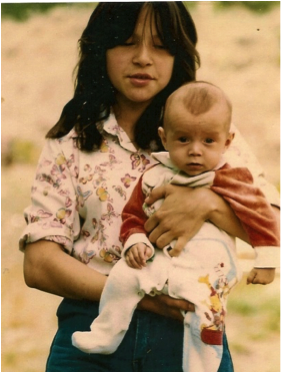
A photo of Phyllis (Jack) Webstad and her son, who was born when she was 13 years old. (Courtesy Orange Shirt Day Society)
“The color orange has always reminded me of that and how my feelings didn’t matter, how no one cared and how I felt like I was worth nothing. All of us little children were crying and no one cared,” Webstad wrote.
The orange shirt now symbolizes everything that was stolen when 150,000 First Nations, Inuit, and Métis children were taken from their families and confined in conditions that constituted cultural genocide over the course of 150 years.
The non-profit organization says seeing people across the country now wear orange is a sign of encouragement, and acknowledgement.
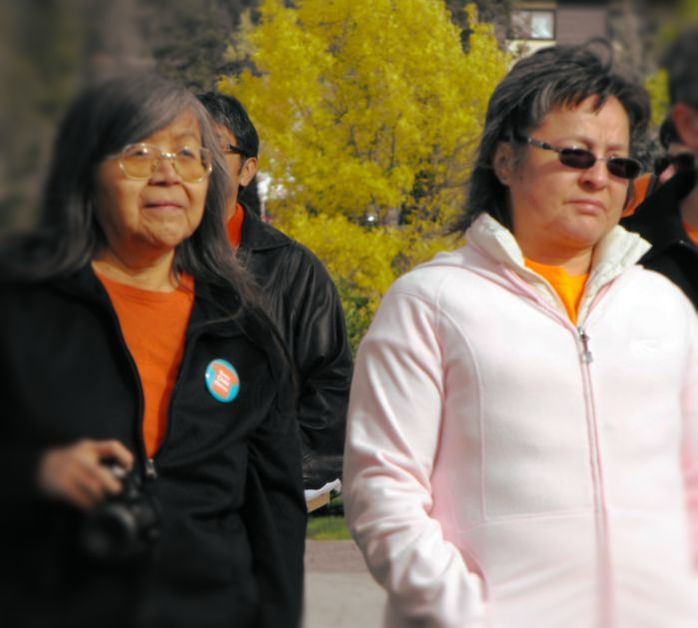
Phyllis (Jack) Webstad continues to share her story about her time at a residential school.
“We’ve heard many Indigenous people talk about when they see someone wearing an orange shirt, that means that person is ready to listen, that person is ready to learn,” Beauchamp said.
“I think once people have listened to what’s happening, they have learned a bit more about it, they will be able to choose actions that will really help,” he added about the efforts to educate. The society also helps teachers with educational tools in order to bridge the gaps between non-Indigenous and Indigenous people.
Watch Related:
On Wednesday night, residential school survivors like Levinia Brown shared their stories on Parliament Hill.
“I want to recognize the survivors across the country who are sharing their truth. They are not only reliving their trauma to help others understand, but they are also speaking for those who could not,” she said.
“As one survivor, I would never have imagined that we would have a day that honours survivors and remember the children who never made it home,” she said from Ottawa.
Prime Minister Justin Trudeau said this day isn’t just for Indigenous people. It’s for all Canadians to come to terms with an ugly side of this country’s history.
Unmarked grave investigations continue
In recent months, several First Nations in B.C. and Saskatchewan have identified what are believed to be hundreds of Indigenous remains in unmarked graves on former school grounds using ground-penetrating radar.
In May, the Tk’emlúps te Secwépemc First Nation confirmed, using ground-penetrating radar, that the remains of 215 children — some as young as three years old — had been found.

The Kuper Island School on Kuper Island near Chemainus opened in 1889. (Courtesy: National Centre for Truth and Reconciliation)
The Penelakut Tribe in B.C.’s Southern Gulf Islands confirmed in July that 160 undocumented and unmarked graves are at the site of the former Kuper Island Residential School.
In August, the Williams Lake First Nation began the lengthy process of a comprehensive ground analysis of the land surrounding the former St. Joseph’s Mission Residential School, where Webstad was sent.

The site of the former St. Joseph’s Mission Residential School in Williams Lake. (Courtesy: Williams Lake First Nation)
Through speaking with survivors, as well as examining the archival records from the Archdiocese of Vancouver, they are able to find out more about the students who were forced to attend the school, the First Nation said.
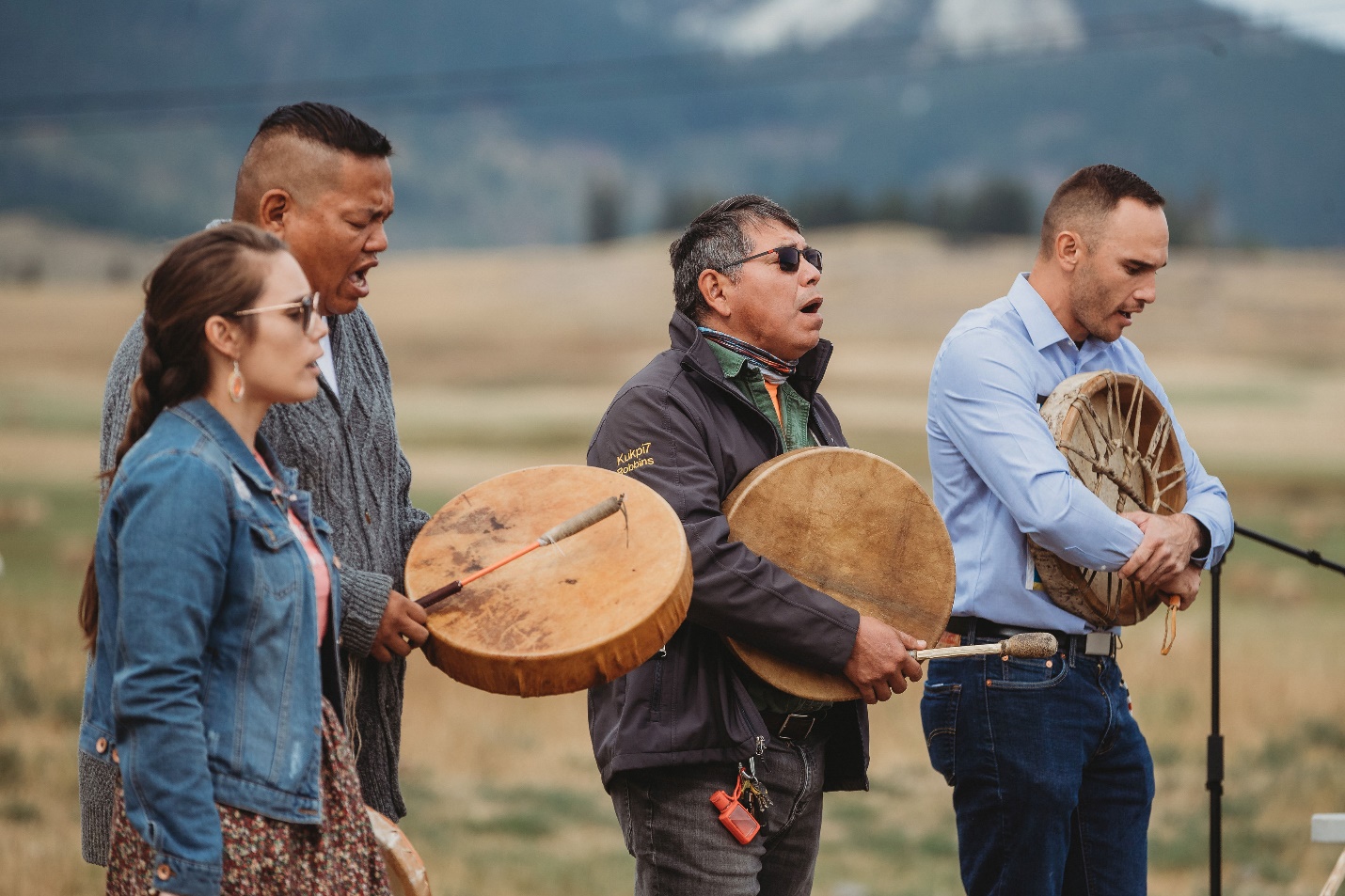
A ceremony to commence the ground investigation of the lands surrounding the site of the former St. Joseph’s Mission (SJM) Residential School was conducted on Monday, August 30th. (Courtesy: Williams Lake First Nation)
The First Nation has been open and sharing updates on the investigation on its website each week and is expecting to find out more details within a month.
Related Articles:
-
‘It took science to wake the world up’: Kamloops residential school findings released
-
Have Indigenous issues taken a backseat during this federal election campaign?
-
B.C. First Nations launch investigation at former St. Paul’s residential school
One of the 94 Calls to Action of the Truth and Reconciliation Commission was for the pope to apologize for the role of the Church. Calls for the pope to come to Canada to apologize personally have not been heeded. A delegation is expected to arrive in December from the Catholic Church, but the Tk’emlúps te Secwépemc has repeatedly said the pope would need to see the site firsthand in order to have any formal apology carry meaning.
Last week, the national assembly of bishops “unequivocally” apologized for the years of trauma.
“We acknowledge the grave abuses that were committed by some members of our Catholic community; physical, psychological, emotional, spiritual, cultural, and sexual,” reads a statement from the Canadian Conference of Catholic Bishops (CCCB) last week.
Tk’emlúps te Secwépemc Kukpi7 (Chief) Rosanne Casimir says the apology is hollow because records linked to the former Kamloops Indian Residential School have never been shared.
“Reconciliation requires truth. Steps towards reconciliation demands honesty and transparency. Tk’emlúps te Secwépemc finds the apology’s commitment to continue the work of providing documentation or records cynical,” she said Thursday.
She says documents dating as far back as 1935 are now at risk of being destroyed.
“Tk’emlúps te Secwépemc call upon the Canadian Conference of Catholic Bishops to work with us at TTS to implement any and all outstanding calls to action from the Truth and Reconciliation Commission. We know that many questions remain.”
B.C. promises to help survivors heal
There were 18 residential schools that operated in B.C. The last to close was in 1984 after 121 years in operation, according to the province.
The B.C. government has promised to assist communities search the unmarked graves at the sites of former residential schools in the form of a $12 million response fund.
The process is expected to be very expensive and traumatic for survivors, and the government says it will also allocate more funds towards healing programs.