Will you be able to see the northern lights in Vancouver?
Posted July 12, 2023 4:17 pm.
Last Updated July 12, 2023 6:47 pm.
It’s been widely reported that a solar storm forecast for Thursday is expected to give skygazers in many areas a chance to glimpse the northern lights.
But will people around Vancouver actually be among those able to take in the aurora borealis?
A change in the forecast may not be what many had hoped for.
“Earlier in the week, I would have said yes. I was looking at reports from the University of Alaska Fairbanks aurora watchers, that’s where a lot of the information that was pulled from different reports came from,” Marley Leacock, an astronomer at the H.R. MacMillan Space Centre in Vancouver, explained.
“They had the possibility of these very active aurora, actually a geomagnetic storm, which is when the sun’s activity influences earth’s magnetosphere a lot. But now, they’ve revised their predictions. They usually do three days out.”
She says the organization generally does a 27-day forecast, which, in this case, had “pegged Thursday as a very active day.”
“Now, they’ve revised it and it’s less active. So the chances of seeing the aurora, unfortunately, have kind of dropped with that change in prediction,” Leacock told CityNews.
According to the scientist, the strength of the aurora is now listed as Kp4 on the K-index for Thursday.
It was listed as Kp6 earlier in the week for that day, she adds, noting that is “very, very strong.”
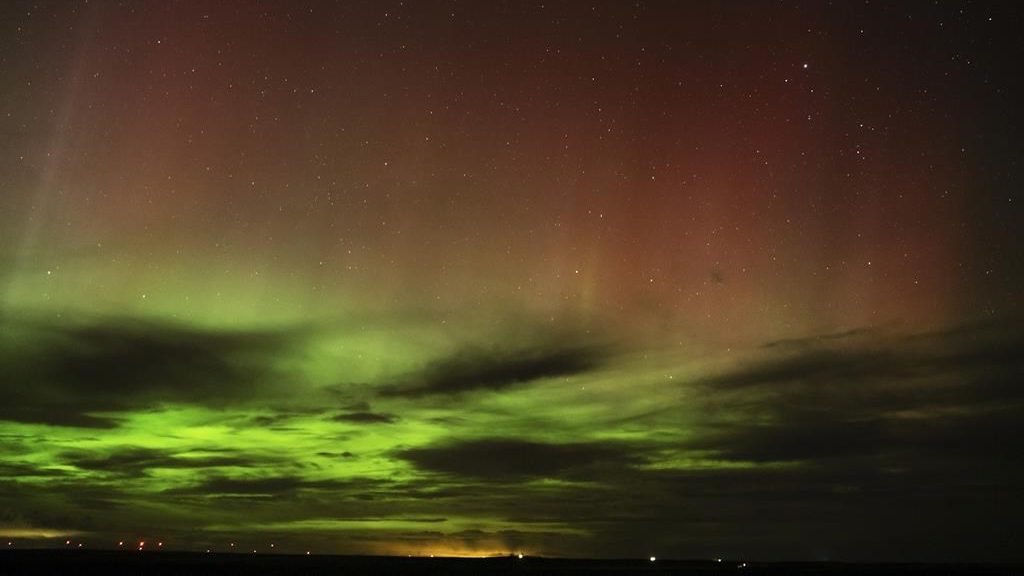
“[People] might see something, it just won’t be like the bright colourful green that you’re thinking that you’ll see. I’ve heard it described as like a weird-looking cloud, so it’s not quite colourful but there is some movement that you’re able to see. For us in Vancouver, it will be very low on the horizon as opposed to right up ahead of you,” Leacock said.
Despite this change in forecast, Leacock says all hope is not lost for people around Vancouver who are hoping to catch a glimpse of the northern lights.
“With Kp4, if you have a long exposure time, you can start to see some colour. That happened I think earlier on in the year, when it was like a Kp4, Kp5 value that people with a long exposure time were able to get colour. So it’d be worth it but you want to get far out of the city, (find) dark skies,” she added.
Related articles:
-
Solar storm to make northern lights visible in Vancouver Thursday
-
Saturn’s rings are glowing in Webb Space Telescope’s latest cosmic shot
-
Jupiter’s moon count jumps to 92, most in solar system
The aurora many people know about is generally described as a colorful sky show that happens when solar wind hits the atmosphere. It often appears as green, purple, and red in the night sky.
The Geophysical Institute at the University of Alaska forecast earlier this week that, weather permitting, displays would be visible over much of that state, as well as Inuvik, Yellowknife, Rankin and Iqaluit to Juneau, Edmonton, Winnipeg and Sept-Iles.
In addition, it said the northern lights may be visible “low on the horizon” in Vancouver Wednesday and Thursday.
The forecast for Vancouver Wednesday night features a clear sky, with potentially a few clouds.
“The night sky will be clear or close to it the rest of the week and into the early part of the weekend,” added CityNews Meteorologist Michael Kuss. “Friday and Saturday nights may be a little hazier as wildfire smoke has the potential to reach the Lower Mainland.”
Leacock says much of the excitement around the aurora borealis in the Vancouver region comes from the fact it’s not often visible this far south.
“In terms of activity, it’s largely tied to the solar cycle more than anything. So right now the sun has entered and is heading toward a period of high activity, or the solar maximum, which is when it peaks, and that’s supposed to happen in 2025,” she explained.
She says as we move closer to a solar maximum, there’s more and more activity, which will ultimately increase the “strength and chances of the aurora.”
How to see the aurora
So if you do want to look for the aurora, what should you do? Leacock doesn’t recommend a telescope.
That’s because you want to see as much of the sky as possible, she says, adding a telescope zooms in on one section of the sky.
Instead, she says your eyes should suffice.
“And something comfortable to sit on and a lot of time,” Leacock told CityNews, adding you may also want to bundle up, depending on how cold it is.
She adds the best time to see the aurora is usually around midnight.
“You want the sun to have for sure set, you want twilight, all the light residual to be gone. So I think (the University of Alaska) Fairbanks usually has anytime between 9 p.m. and 3 a.m., but I think sunset is just after 9 p.m. or just before now, so you want to shift that by an hour maybe … or even a bit further,” Leacock said.
-With files from Sarah Chew