Canadian experience: OMNI poll finds majority of newcomers struggle to find a job
Posted December 8, 2025 3:01 am.
Last Updated December 8, 2025 7:59 am.
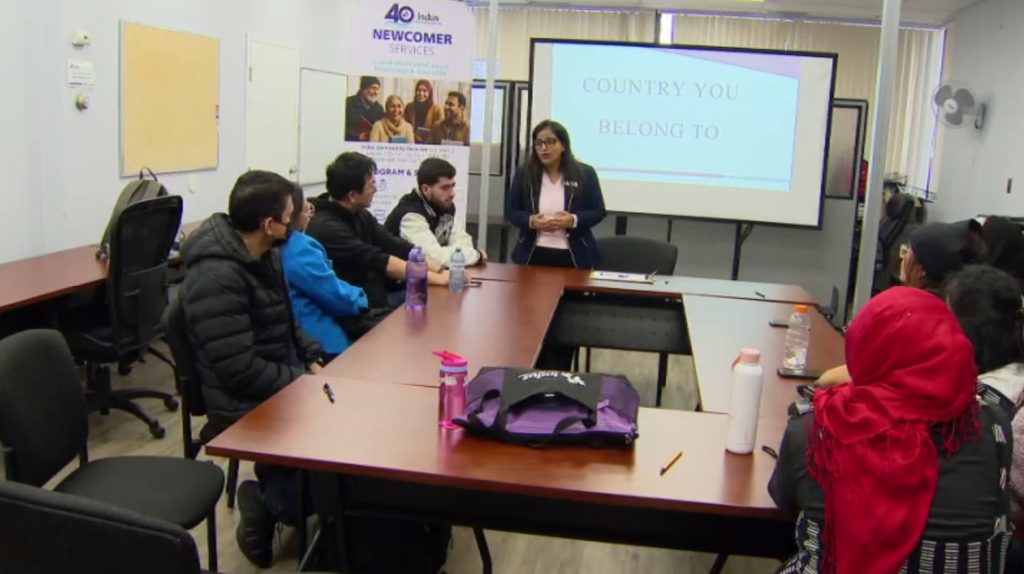
Sitting around a large table under a banner that reads, “Country you belong to,” the students in the English class offered by a settlement agency share something about their homeland that others might not be familiar with.
“In Taiwan, you always hear car sounds. Motorcycles. Even at midnight,” says Eric Kuan Hung Lin, who moved to Mississauga, Ont. about two years ago. “Here, you have quiet at night.”
He is trying to get more opportunities to practise his language skills in person, with other people.

“I don’t know why, but if I have to use English, I’ll feel shy sometimes,” he explains.
Lin, who works at a grocery store not too far from the settlement agency, is also hoping that with more practice, he’ll have better luck landing a job that aligns with his background in television production.
“You can find a job easier, a survival job,” he tells OMNI News. “But if you want to do your professional job, you need time, a social network, even education, and Canadian experience.”
Judy Labelle, one of the directors at Indus Community Services, notes that language “tends to be a barrier” for many of the clients, like Lin, she sees at the agency.
According to a Leger poll conducted exclusively for OMNI News, a majority of immigrants say that they have faced barriers in the workplace, including their accent and language proficiency.
Such barriers are “more acute” among younger newcomers who have been in the country for less than six years, explains Andrew Enns, Executive Vice-President at Leger.
“They’re trying to get themselves established. Yet, they’re not as proficient in English because they simply haven’t been here as long,” he says. “But I think it’s also somewhat encouraging that as [they spend more time] in the country … those barriers to employment seem to go down.”
However, other challenges might be harder to overcome, even for those who managed to enter the workforce.
Lack of foreign credentials recognition remains a barrier to employment
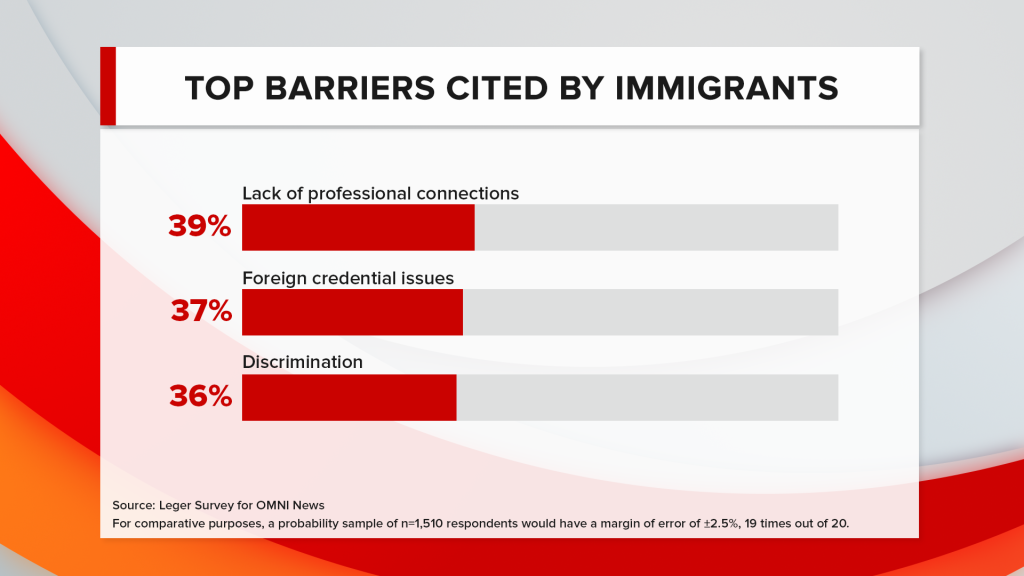
The OMNI-Leger poll found that bias and discrimination, a lack of professional connections, and the struggle to get foreign credentials recognized were the top three reasons why, for over 50 per cent of newcomers, it is harder to advance in their careers.
The federal government set aside $97 million over five years in Budget 2025 to create a Foreign Credential Recognition Action Fund that promises to help internationally trained workers get their skills recognized faster.
For some, time is of the essence.
Qusai Razouk had four years of experience working as a structural engineer in Dubai when he moved to Toronto with his wife to pursue a PhD.
Now, as they get ready to welcome a new baby, he feels pressure to start a career and support his family.
“My colleagues, some of them, wait six months to find a proper job. We cannot survive this,” he tells OMNI News. “If I find a job in the USA, or Europe, or back in the UAE, I will go directly. I could not wait.”

A recent report by the Conference Board of Canada and the Institute for Canadian Citizenship warns that highly skilled immigrants and those with higher education levels are the most likely to leave Canada.
The report concludes that “more can be done to ensure that immigrants not only enter the workforce quickly but thrive while they’re here,” – a lesson Harleen Kaur learned firsthand.
She spent the better part of the eight months she’s been in Canada working survival jobs while looking for a position in her field.
“Most of the jobs were asking for a licence and certifications, but I couldn’t afford to get them as I didn’t have any job to support me,” she told OMNI. “Employers also wanted Canadian experience, which I didn’t have because I am new in Canada. How would I have Canadian experience?”
Ontario to ban Canadian job experience requirements in 2026
As of next month, Ontario will become the first province to ban employers from asking for Canadian work experience in job postings or in interviews.
But in the meantime, the OMNI-Leger poll found that immigrants’ views on the challenges they face in the workplace have remained largely unchanged, including when it comes to the lack of Canadian experience.
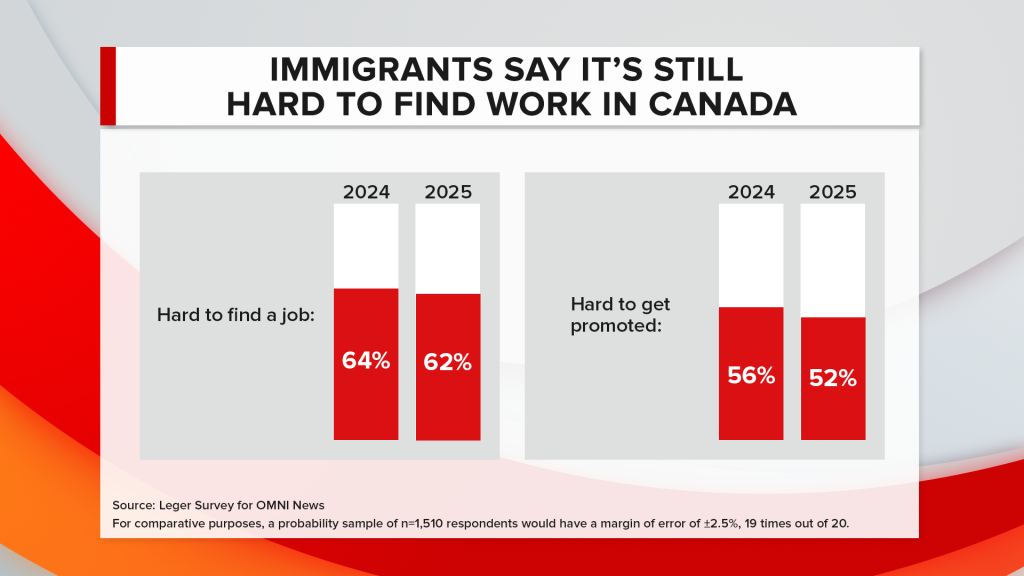
Overall, more than 60 per cent still believe it is hard to find a job in Canada, and 52 per cent say that it is more difficult to get a promotion.
Kaur, who eventually got hired as an accountant, admits that sometimes she regrets coming to Canada.
“I might have had better growth if I had stayed back home,” she tells OMNI. “But now I am here and have a job, and I have a positive feeling that if I work hard and get the job I desire, maybe in a few years I will be able to build the happy life I want.”
—
The poll was completed between Oct. 2 and Oct. 15, 2025, among 1,510 respondents who were all born outside Canada, using Leger’s online panel. No margin of error can be associated with it.
This story is part of a series from OMNI News with data being released throughout the month.