What is a Goosinator? A look at how Canadian cities address geese
Posted May 12, 2023 10:44 am.
Last Updated May 12, 2023 12:57 pm.
“A predator under man’s control.”
While it sounds like something out of a dystopian Hollywood film, it’s actually just one of the devices the Vancouver Park Board is considering using to manage the city’s Canada goose population.
The predator — a Goosinator — could be utilized as a part of the park board’s plan to “haze” or bully the geese. Other options in the management plan approved by commissioners during this week’s meeting could also include addling, freezing eggs, and, as a last resort, “humanely” killing the geese.
But what is the Goosinator? And what else could the park board use to control the infamous cobra chickens?
The creator and owner of the remote-controlled Goosinator, Randy Claussen, tells CityNews that since the COVID-19 pandemic began, cities around North America have realized they need to do something about their growing geese populations, as more people spend time outside in parks and on sports fields.
“You need to keep it sanitary. Dogs eat [goose poo] and then get sick. People don’t like it,” he said, adding a single goose can poo between 30 to 50 times per day.
“Ironically, geese like the same things we do. In other words, they like short grass, not long grass out in the middle of the field — where we wouldn’t mind them being. They like short grass, and then they like open water without longer grasses because longer grasses hide predators,” he explained.
Related Articles:
-
Focus on humans, Vancouver animal law lawyer says of goose management plan
-
Vancouver Park Board approves ‘lethal removal’ in Canada goose management plan
The Vancouver Park Board estimates the Canada goose population in the city will expand dramatically over the next few years. The current 2,200 geese are expected to grow by 20 per cent each year to 10,000 by 2030 unless action is taken.
While the Goosinator itself might look a little goofy considering the real and serious impacts geese have on green spaces in urban areas, Claussen explains that the form in which this man-controlled predator comes is very intentional.
“Geese are the smartest waterfowl bird out there. They know the difference between a real predator and just a manmade nuisance,” he said. “Cornell University did a study on all the characteristics that geese hate the most, and there’s no big surprise there.
“They don’t like big eyes, they don’t like big teeth. They don’t like the colours red, black, or silver. They don’t like anything reflective, they don’t like swept-back ears.”
The Goosinator functions similarly to other remote-controlled devices. However, where it shows its difference, is how it can also scatter birds from bodies of water — something that other methods of geese management can’t do.
“It’s best if you act like a predator,” Claussen said. “I tell [people], ‘When’s the last time you seen a coyote run all over the place trying to get a goose?’ They don’t do that. They heard them all up, and then they get them all to fly.”
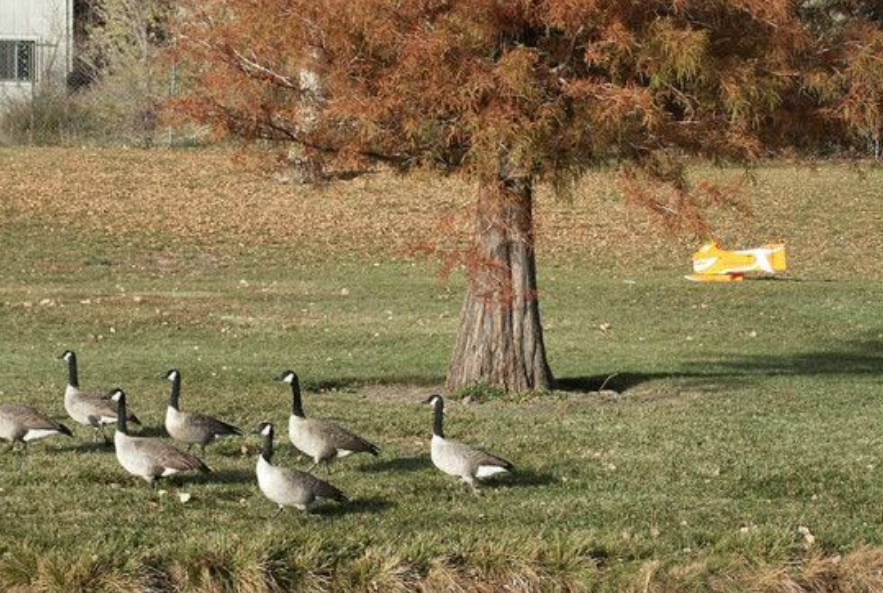
A Denver, Colorado, based company’s goose-deterring device, the Goosinator, is one of the options the Vancouver Park Board is considering using to control the city’s Canada goose population. (Courtesy: Goosinator)
Claussen says it takes about four to six days of regular use of a Goosinator to change the behaviour of resident geese, however, it’s best to use the device for as long as possible. Even just having the Goosinator out in open view of the geese will make them stay away, he explains.
“I have a two-week chasing protocol. … And then what happens is, the message that you end up teaching them is that, ‘God, we can’t even be at this place for five minutes and that thing comes after us.'”
Based in Denver, Colorado, Claussen says he first sold the Goosinator to golf courses across that community, with the City and County of Denver eventually purchasing six devices. Claussen also says New York, Los Angeles and 300 other places around North America use the Goosinator.
Other goose-deterring methods
But the devices themselves are expensive. Each unit is about $4,000 USD, Claussen explains.
Because of that, some cities and private businesses use other methods, which Claussen explains could include using dogs, sound machines that send “big booms,” or spraying grasslands with grape seed extract — “a citrus-based [spray] that makes grass not taste good.”
The Vancouver Park Board isn’t the only jurisdiction in Canada looking for creative ways to control geese.
The Resort Municipality of Whistler (RMOW) even has its own volunteer hazing program, which employs residents and their dogs to chase geese out of their parks.
“Hazing geese with dogs is an effective deterrence technique and a key part of our geese management strategy,” the resort municipality said.
“Volunteer to walk your dog and haze geese for a minimum of three weekdays (Monday through Friday) per week, either in the mornings or evenings throughout spring and summer. Dogs are to run or swim towards geese to scare them off of our beaches (CARDA dogs or obedient, trained dogs that chase balls are well suited).”
Even the federal government has used dogs to get rid of geese on its properties. Back in 2012-2014, Agriculture Canada issued a tender for dawn and dusk dog patrols, five days a week, across 300 hectares of fields at an Ottawa farm which is used to develop new crops.
At that time, two border collies and a trainer were hired for $44,000 to drive away more than 1,000 geese, which are notorious for gobbling up seeds from the federal government’s newly sown fields — ruining hundreds of thousands of dollars worth of experiments.
Meanwhile, Environment Canada published a handbook back in 2015 offering advice on how to properly frighten a Canada goose causing damage to your property.
Suggestions include air horns, strobe lights or lasers, shiny streamers, and helium balloons with graphics of large eyes.
Scarecrows are apparently also a good option, with the most effective being effigies of humans, eagles, or alligators.
CityNews has reached out to the RMOW to understand why dogs have been chosen to control its goose population.