ICBC sounds alarm as survey finds staggering number of B.C. drivers tailgate
Posted June 24, 2025 11:58 am.
Last Updated June 27, 2025 11:43 am.
Let’s be honest: Do you tailgate when on the road?
If so, you are not alone. A staggering 77 per cent of drivers in B.C admit to tailgating, a practice that significantly compromises road safety.
This is one of the many results of the most recent survey by the Insurance Corporation of British Columbia (ICBC).
While half of drivers say they tailgate because the car ahead is going too slow, 86 per cent feel frustrated, angry, or intimidated when they are the ones being tailgated.
This survey’s finding paints a vivid picture of driver behaviour and perception.
CLICK HERE TO LISTEN TO 1130 NEWSRADIO VANCOUVER LIVE!“It is a classic case of ‘do as I say, not as I drive’, proving that when it comes to the road, we are not always as patient as we like to think,” said ICBC in a statement.
However, ICBC says the alarming and partly contradictory statistics come as no surprise.
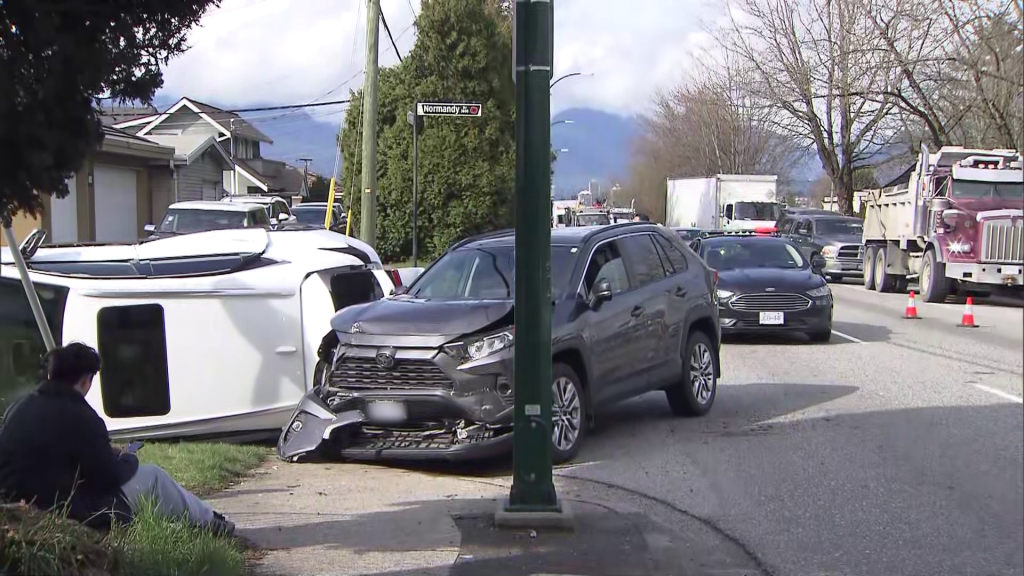
The insurer reports over 57,000 rear-end collisions in the past year alone, with tailgating consistently identified as a primary contributing factor.
Most tailgating happens on city streets
The survey’s findings also include where tailgating occurs the most, with 84 per cent of drivers saying it happens at least sometimes on city streets.
Based on the survey, that is two per cent more than on the highway.
“A safe following distance isn’t just a courtesy, it’s a critical part of keeping everyone safe,” said Kathleen Nadalin, ICBC’s road safety program manager, in a statement.
Faced with tailgaters, B.C. drivers react in various ways, the survey finds: 41 per cent move lanes, 28 per cent ignore it, and 11 per cent pull over.
However, according to the survey, some resort to riskier tactics: nine per cent deliberately slow down, and seven per cent speed up to create space.
“Remember, the only place tailgating is fun is at a football game, not on the road,” said Nadalin.
Tailgating drastically reduces a driver’s reaction time and elevates the risk of a crash, the province’s insurance provider explains.
“If you are tailgating or following too closely the vehicle in front of you, you have less time to react,” Greg Harper, media relations advisor at the ICBC, told 1130 NewsRadio.
“Your vision is limited as well. You can’t see a potential hazard that may be up ahead. And if that vehicle in front of you suddenly comes to a stop, it puts you in a situation where you have to slam on your brakes.”
ICBC reminds drivers to maintain a safe following distance of at least two to three seconds, and at least one car length when stopped.
“Nobody wants to get into a crash, so if you don’t tailgate, you reduce your chances of getting into a crash significantly,” Harper said as he stressed the importance of keeping a safe distance when on the road.
This recommended distance should increase when following a larger vehicle as a truck, as this can limit your vision even more. The same applies if behind a motorcycle, as these can stop very quickly.
Generally, anything that limits your vision or impacts your reaction time, such as poor weather conditions, should increase this distance.
Harper wants to remind every driver that crashes can also injure people.
“In some cases, this damage to the vehicles could be minor, but it could be significant. But then there’s also a chance of people getting injured as well,” he emphasized.
How to determine a safe distance
A rule-of-thumb to determine the distance is to select a fixed object at the side of the road, like a tree or street sign, and then count the seconds when the car in front of you passes it, and stop when you pass it.
If you count to 3 before you pass the object, you are maintaining a safe distance from the vehicle in front of you.
Harper also speaks on the insurance costs every vehicle owner must carry, as the probability of crashes is high, and B.C. roads become busier.
“If you’re at fault in a crash, that’s likely to impact your premiums going forward, so you’ll end up paying more to insure your vehicle,” Harper reminded drivers.
“Dealing with a crash is one thing, but then paying more for your insurance, that’s something else to consider as well.”