B.C.’s economic forecast for 2026 grim: report
Posted January 7, 2026 7:26 am.
Last Updated January 7, 2026 7:31 pm.
A new report from Deloitte is pouring cold water on B.C.’s economy as 2026 begins.
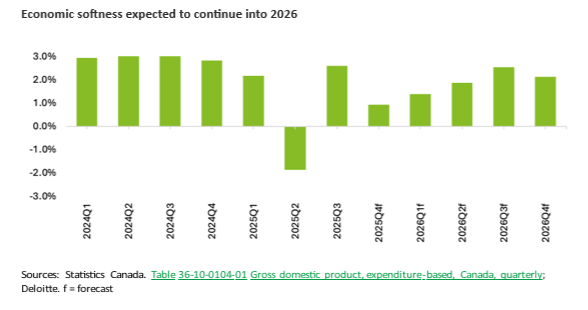
The financial firm finds economic growth in the province is expected to remain weak, growing only 1.6 per cent.
CLICK HERE TO LISTEN TO 1130 NEWSRADIO VANCOUVER LIVE!Deloitte’s chief economist, Dawn Desjardins, admits to 1130 NewsRadio that it’s going to be a difficult year with U.S.-imposed tariffs being the biggest obstacle.
“That is having a significant impact on the provincial economy when we think about what’s happening in the lumber industry… and we’re not entirely certain how it’s going to play out,” said Desjardins, referring to the Canada-United-States-Mexico Trade Agreement (CUSMA) slated for review this year and the need to restart talks with the U.S.
Currently, no talks have been scheduled.
Desjardins says what’s going to be key — and it’s already happening — is for the province and the country to diversify trade with almost anyone who will listen.
“Forging new relationships with other countries; Having the ports so we can ship things out in an efficient way; those things will go some distance, I think. The other thing we have to think about is the burdens on companies expanding at home. We’ve seen good steps taken to reduce interprovincial trade barriers, reduction of some of the regulatory burdens that for companies that are looking to put money to work, this is the cost to them, and it could sway them from getting these projects underway.”
Simply put, she says provinces need to cut the red tape to make Canada more attractive.
“They have the capital. They are wanting to see return on that investment. It needs to be quicker because we know capital is extraordinarily mobile in today’s economy and companies are not patient,” explained Desjardins.
“No one is going to replace the U.S. as our biggest trading partner.”
If relations don’t improve with the U.S., she says Canada will need to lean into investing at home, which means increasing the housing stock, protecting Canadian jobs and supporting industries that need federal funding.
“These are all ambitious goals and certainly things we should be striving for, but we have to be aware that it takes time, and it takes labour. That’s one of the things we looked at… and our analysis suggests that we’re shy about 500,000 workers [nationwide], so we have to dig in there. No one is going to replace the U.S. as our biggest trading partner. I think the geography, the integration of supply chains, we know that hill is extremely high to climb. But at the end of the day, and this is an assumption in our forecast, but we do think we will continue to have, generally, pretty open access to the U.S. markets, meaning as long as our goods are compliant with the agreement.”
As tough as Deloitte’s report is about the immediate future, Desjardins says there is some hope to help balance things out.
“LNG Canada is helping the economy. Interest rates have come down significantly, and that should alleviate some pressure in households which are having to renegotiate their mortgages. Additionally, some federal funding to help some of the very hard-hit industries — lumber, aluminum — that too, will provide some support for the economy.”
B.C.’s economy coming to a standstill in the backdrop of rising debt levels is not good news. The province’s forecasted deficit hit a record high of $11.6 billion for the first quarter of the 2025-2026 fiscal year, which the province blamed, partially, on the elimination of the carbon tax amid “global trade uncertainty.”
Finance Minister Brenda Bailey also projected higher debt levels through to 2028, with it projected to rise to more than $212 billion in 2027-2028.
On a national scale, Deloitte says, Canada’s economic growth this year will slow to 1.5 per cent, from 1.7 per cent last year, though with hope that growth will pick up in the back half of 2026, setting up a stronger 2027.