Canucks Takeaways: Comeback attempt too little, too late vs. Sabres
Posted January 7, 2026 6:26 am.
The Vancouver Canucks and the Buffalo Sabres entered the NHL as expansion cousins in 1970. In that time, they’ve both had their dominant eras, have been to the Stanley Cup Final, lost the Stanley Cup Final, been through periods of darkness and have the same number of championships under their belt — zero.
But the Sabres have won 11 of their last 12, including a 3-2 win in Vancouver in December that proved to be Quinn Hughes’ last game with the franchise. The Canucks traded their captain and best player, dropping down to the league’s basement in the process.
There’s no doubt that the Sabres have gone through the wringer to get to this point, and it’s unclear if the success under new general manager Jarmo Kekalainen is sustainable or indicative of the future.
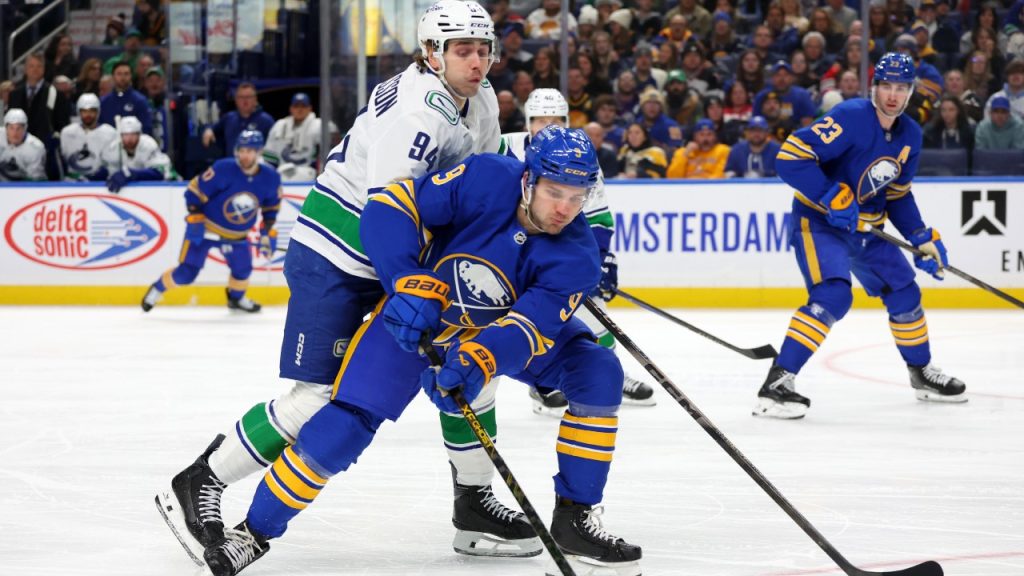
But their play has thrust them right into the playoff picture, and on Tuesday night, in front of a lively crowd at KeyBank Center in Buffalo, the Sabres served up a 5-3 win and more optimism than the team has felt in years.
For the Canucks, on the wrong side of the scoresheet for the 26th time this season, it was another reminder of how far they have to go to be truly competitive again.
Don’t let the score fool you — this game was only close for, approximately, the final 10 minutes, when the Canucks mounted a futile comeback and peppered goaltender Ukko-Pekka Luukkonen with chances.
For two-and-a-half-periods, the Canucks looked to be chasing their tails.
The Sabres pressured early and often and needed only two minutes before their efforts were rewarded. Tage Thompson, fresh off his Team USA Olympic nod, took advantage of the Canucks’ sloppy coverage in the slot, corralling a loose puck and sending it right past goaltender Thatcher Demko.
Before the period was up, Ryan McLeod’s short-handed snipe doubled the lead. Later markers from Alex Tuch and Zach Metsa, his first in the NHL, seemed to put the game away for the Sabres, before the Canucks scored three goals in five minutes that, bluntly, stunned everyone.
It was all for not, and the Sabres walked away with the victory that, frankly, they deserved.
“We put ourselves behind the eight-ball a little,” head coach Adam Foote said post-game. “It seemed like it rattled us longer than it usually does, as a group. Usually we bounce back a little bit quicker than that, but we seemed to find a way to get some jump later in the game. Just a little bit too late.”
The Canucks face an even tougher test on Thursday, when they take on the Atlantic Division-leading Detroit Red Wings.
Too little, too late after a tough start
The Sabres clearly did not take Saturday’s snapping of their 10-game win streak lightly and came out of the gate swinging against the Canucks. Not only were their chances finding the back of the net, but they looked faster, more complete and more coordinated as the game progressed.
Frankly, the score could have easily read 5-0 or 6-0 by the middle of the third, had it not been for some well-timed saves from Demko.
The Canucks’ comeback was too little, too late — especially after a start like that.
“We weren’t ready to play,” forward Jake DeBrusk said post-game. “That’s on us. Demmer kept us in it, and I like the fight we had in the third period.”
For 10 minutes in the final frame, the Canucks were creating Grade-A chances, testing Luukkonen and forcing him to be sharp with a few athletic saves. The Canucks, however inconceivable it felt, came inches away from tying the game in that time.
It’s a shame they waited 50 minutes to bring that effort.
Their ill-fated comeback started when DeBrusk got the Canucks on the board after drawing a four-minute power play after he was high-sticked.
Elias Pettersson scored less than five minutes later, still subdued in their celebration, until rookie Liam Ohgren scored his third with the Canucks, going his signature five-hole to bring his team within one.
“It seemed like it sparked us for sure,” Foote said. “We were coming and they were sitting back. It happens.”
Knowing the Canucks are capable of playing a competitive game is perhaps more frustrating than if they weren’t. Aside from that stretch and a first-period power play that yielded six shots, the Canucks looked to be at the mercy of the surging Sabres.
If they want to win games, or at least play a competitive 60 minutes, they can’t take more than two-thirds of the game to warm up.
Foote calls out veterans
Key Canucks veterans (read: Brock Boeser, Pettersson, DeBrusk, Filip Hronek, Marcus Pettersson) managed to get on the scoreboard in the third-period frenzy, but Foote still had words about the play of his seasoned Canucks.
“We started OK, but when the two went in (in the first period), I’d like to see us calm down a bit. I’d like to see our leadership group grab that a little quicker rather than let it linger like it did. Usually we’re better about that, but we’ll talk about that,” Foote told reporters in Buffalo.
“Anything. More of just (playing) and settle things down,” he continued when asked what he would liked to have seen from his vets. “There’s lots of game left at that moment. We got back, but I thought it was just… We could have got back a lot sooner.”
Despite their mark on the scoresheet, Boeser, Pettersson (the forward) and DeBrusk all finished with negative goal differentials. Pettersson, Evander Kane and Boeser were all on the ice for Metsa’s game-winner and for 50 minutes, all were failing to make the kind of impact on the game that they’re expected to as vets.
In a time of rebuilding — hybrid or not — score matters less than process, and if the Canucks want to develop their young players, it’s up to the veterans to lead by example.
Short-handed scaries
By allowing a short-handed goal to McLeod in the first period, the Canucks are now tied with the New York Rangers and San Jose Sharks for most allowed shorties against, with six.
The Canucks also attempted to score their own sixth short-handed goal after Sherwood and Drew O’Connor sprung out on a 2-on-1, but the effort was foiled by Luukkonen.
Tank check
Bad news first: The Winnipeg Jets lost their 10th game in a row in overtime on Tuesday, widening the gap between them and the 31st-place Canucks with a 15-21-5 record. They have a game in-hand on the Canucks, but their next two opponents — the Edmonton Oilers and Los Angeles Kings — are playoff teams, making a win significantly more challenging for the Jets.
Per Tankathon.com, the Jets have a 25.5 per cent chance of landing the first-overall pick, compared to Vancouver’s 13.5 per cent.
The good news? The 2026 draft is projected to be deep, and the Canucks’ chances of landing the second, third or fourth pick are 14.1, 30.7 and 41.7 per cent, respectively.
If the draft were to happen tomorrow, the Canucks would have more than a good chance at selecting a high-impact player.