What we lost in the slides: backcountry routes on Mt. Joffre gone forever
Posted May 26, 2019 9:01 am.
Last Updated May 26, 2019 9:13 am.
This article is more than 5 years old.
PEMBERTON (NEWS 1130) – Professional skier Cody Townsend can now say he was one of the last people to descend the Central Couloir on Joffre’s northeast face, at least as the line existed for thousands of years.
The bottom of the Central Couloir was taken out by the second of two massive landslides off of Joffre’s northeast face in May, says geologist Drew Brayshaw, who has analyzed photos of the slides.
RELATED: ‘Waiting to go’: Scientist says third slide on Joffre Peak imminent
A couloir is a steep, narrow gully on a mountainside, and some extreme skiers are adventurous enough to take them on.
“If you can’t ski an extreme couloir, maybe it doesn’t matter to you so much,” Brayshaw says. But for those who could and did conquer the gnarliness of Joffre, those lines did matter.
So far two couloirs and eight rock climbs are likely gone forever, while summer access to the incredibly popular Keith Flavelle Memorial Hut is currently cut off.
Extreme Joffre
There were three difficult couloirs on the aspect of the peak that was impacted by the landslides; Twisted, Central and Joffre. The lines are featured in the notable compendium 50 Classic Ski Descents of North America.
Those lines have claimed lives and limbs and left even the most experienced mountain lovers shaking in their boots.
Townsend, for example, was named skier of the year for his groundbreaking line through a tight Alaskan couloir in 2014, but Joffre’s intense conditions nearly bested him this winter.
The Salomon athlete has been trying to tick off all 50 of the descents on the list and featured Central Couloir in his YouTube series, The Fifty, in April.
The bonus episode that follows perfectly captures just how quickly things can go wrong on the dramatic northeast face when Townsend and his partner had to rescue another man who fell out of the bottom of Central.
Rock and ice
Joffre is just as well known for its world class rock and ice climbing and routes that require ascent over both mediums for an experience known as “mixed climbing.”
It’s a mountaineering destination, with first ascents documented in the early 1970s through to the early 1990s.
Brayshaw, who has been keenly sharing his professional insights into the slides and the latest crack that’s threatening a third landslide, is actually more interested in the climbing routes than the geology.
So the Chilliwack-based climber and scientist has been pouring over aerial footage and photographs gathered by hiker Wilfried Braun and pilot Daniel Jun on Saturday, May 18.
He estimates eight climbs are gone forever.
“Particularly good climbs, climbs that some people have said were among the better climbs in Southwest B.C., are gone now, like completely gone,” he says.
Fate of Keith’s Hut
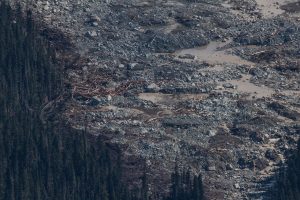
Summer access to Keith’s Hut is completely impassable at this time as much of the trail through Cerise Creek is covered in a debris field.
The Keith Flavelle Memorial Hut is named after one of the region’s pioneering mountaineers and was built in 1988, after Flavelle lost his life on the Yukon’s Mt. Logan.
Tam McTavish is Flavelle’s nephew and helps his family run the hut, which has become one of the most popular backcountry shelters in the province.
“I’m going to miss wandering through the beautiful hemlocks. It was a really gorgeous approach through this older forest and it’s sad to lose that,” he says of the mess made of approach trails through Cerise Creek.
He estimates about 700 metres of trail will need to be completely rebuilt.
McTavish says with the Cerise access blocked, there’s no way of getting to the hut right now, as it is located in a conservation area and motorized access by helicopter is not legally allowed.
His biggest worry, he says, is that a good snow base on top of the new wide, flat debris field will actually make it easier for snowmobiles to access the hut from Duffey Lake Road, something that’s become an increasing issue in recent years as more and more people use the shelter.
“The hut was placed exactly to avoid mechanized access,” explains McTavish. “In winter, it will be much more easy for snowmobiles to get up there.”
Because it’s in the Nlhaxten/Cerise Creek Wilderness Conservation Area, that’s illegal, but McTavish says it hasn’t stopped people from commissioning helicopters and sledding in in the past.
For his part, McTavish has scaled nearby ridges and faces but missed his opportunity to tick the northeast face of Joffre Peak off his list.
He says he’s “a bit bummed to miss the opportunity” but it’s all part of the game.
“There’s an old climbing saying; geological time includes now and that’s definitely very relevant,” McTavish says.