Indigenous veterans honoured for service in North Vancouver event
Posted November 5, 2022 9:17 pm.
Last Updated November 6, 2022 6:47 pm.
As Remembrance Day draws near, a special ceremony honouring Canada’s Indigenous veterans was held in North Vancouver on Saturday.
The event is also running on Sunday from 11 a.m. to 7 p.m.
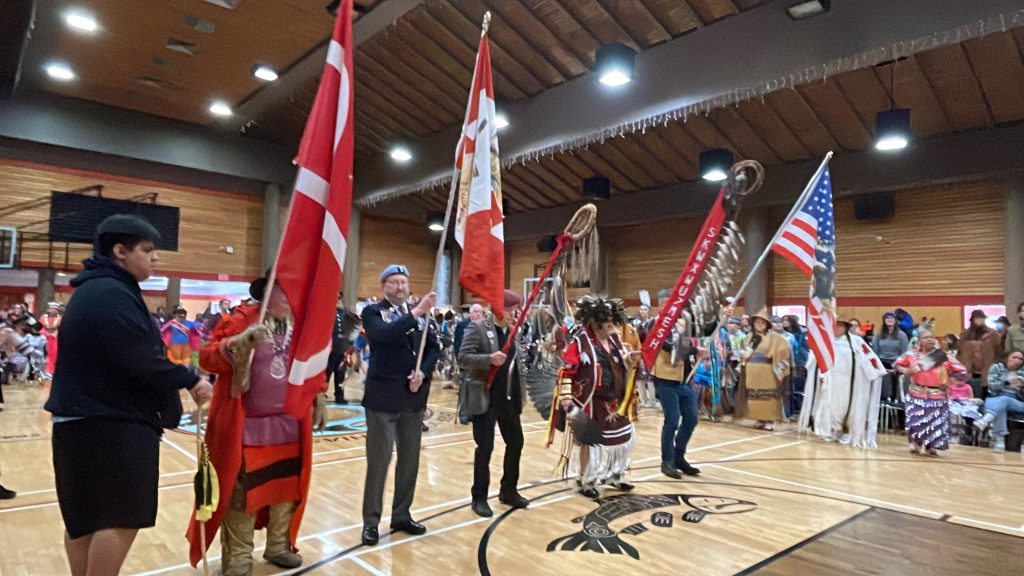
At the Squamish Nations Annual Veterans Pow Wow, dozens of people gathered to celebrate, and remember the contributions Indigenous people had in protecting Canada, and the missions they went on around the world.

At the Chief Joe Mathias Centre in North Vancouver, Indigenous veterans are honoured for their role in the contribution of protecting Canada. November 5, 2022. (Angela Bower/CityNews)
The event was held at the Chief Joe Mathias Centre, and as an act of reconciliation, non-Indigenous people were also invited in the hope of promoting better understanding, and learning about Indigenous veterans.
The ceremony started with a procession, and saw dancers dressed in colourful regalia following the beat from a drum circle.
One veteran who attended the ceremony says his experience was as a “jumper” for the army in the 60s.
“We jumped out of airplanes, helicopters, and anything we could get our hands on,” Guulaans Flewin explained.
Mistreatment, discrimination, and identity
Indigenous people have been part of Canada’s military for over 200 years, and have faced numerous challenges — including mistreatment and discrimination.
“It was a little challenging in terms of ethnicity, because there were a lot of Aboriginal issues going on at the time,” Indigenous veteran Carlyle Natrall explained.
Natrall says he served in the Royal Canadian Navy in the 80s, when he was 19 or 20 years old.
“I was just finding my self, my own identity as being an Indigenous man,” he adds.
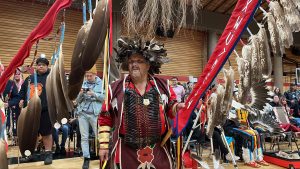
Squamish Nations Veterans Pow Wow on November 4, 2022. (Angela Bower/CityNews)
For Indigenous veteran Kelvin Bee, he says both him and his veteran father were both subject to discrimination.
Although that didn’t stop Bee from joining the military, in fact, he signed up because of his father’s service during World War II.
Bee served in the Royal Canadian Air Force for 10 years during the 80s, and explains how both him and his father lost their status cards in joining the military.
“Being a veteran myself, I lost my status when I signed the document…but I didn’t know what it meant at the time,” Bee said.

On November 5, Indigenous veterans are honoured at the Chief Joe Mathias Centre for their role in protecting Canada. November 5, 2022. (Angela Bower/CityNews)
He explains his father was eventually able to obtain the status once more, but it took time.
“It took my dad three years to regain his status, to regain his rights to his land, his homeland,” he explained.

At the ceremony, many people were dressed in traditional Indigenous outfits. (Angela Bower/CityNews)
Additionally, Bee says that although they both served in the Canadian Armed Forces, at the time they were denied membership to The Royal Canadian Legion — a social club for veterans.
“The Legions at that time were 90 per cent white, and they weren’t interested in having an Indigenous person in their establishment,” he said.
Challenges and changes
When many of the veterans in attendance served in the military, it was mandatory to have their hair cut — something that is associated with cultural identity.
“It goes to a deeper connection to the land where it is very sensitive to the elements, and helps you stay connected,” Natrall explained.
At the Chief Joe Mathias Centre in North Vancouver, Indigenous veterans are honoured for their role in the contribution of protecting Canada. November 5, 2022. (Angela Bower/CityNews)
But now, the rules for have changed and mandatory haircutting is a thing of the past — something that is impacting the next generation of Indigenous officers.
“My great niece told me she’s allowed to have her hair long, and I told her, ‘That’s good, and that makes me proud,’ because I wasn’t allowed too,” Bee explained.