Wheels of justice in B.C. slowed amid forensic lab backlogs

Posted November 9, 2022 6:37 am.
Last Updated November 9, 2022 6:58 am.
It’s taking police in B.C. several weeks, months or even longer to get evidence processed at forensic labs operated by the RCMP.
There are delays in getting those results, which the union representing lab workers blames on a staffing crunch, and all of this is having a domino effect on the justice system.
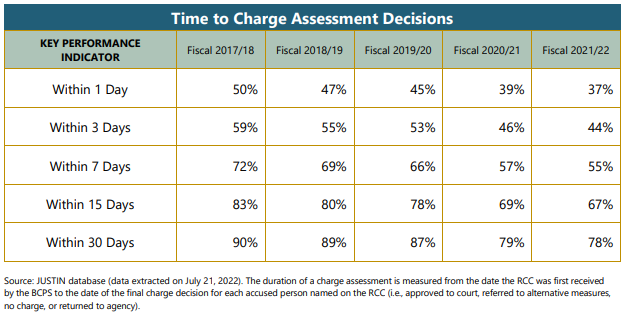
Local criminal defence lawyer Michael Shapray calls these “front-end delays,” because investigations hinge on police getting that evidence and being able to recommend charges to Crown Counsel.
“Prosecutors in British Columbia are the ones who assess police investigations for charge approval, and if it’s a delay in getting lab results or having items analyzed, we’re seeing a much longer period of time until someone knows whether or not they’re going to be facing criminal charges and able to deal with that, and that has ramifications across the entire justice system,” he explained.
Related Articles:
-
Investigating suspects made harder by forensic lab delays: police in B.C.
-
B.C. police investigations slowed as backlogs hit evidence processing
Regardless of whether you’re the accused, a victim, a victim’s family, or a witness — the lives of all these people are in limbo until a case is able to be looked over and make its way through the courts, Shapray said.
“If we have a delay of eight months, 12 months, 14 months at the front end, everybody’s memories, all of the witnesses to that event — they’re now losing some of the ability to recall detail. The longer things take to get to a trial, if there’s going to be a trial, the harder it becomes for the prosecutor to present the evidence because of the delay.”
Shapray says all that waiting can also affect what happens at the trial, should it reach that point.
“You could have a bunch of civilian witnesses who are either partial or direct witnesses to an event that happened, whether it’s an assault on the street, a sexual assault in a house at a party — they may get interviewed quickly by police at the scene. But, if that case takes 12 or 18 months to get into the hands of the prosecutor and a prosecutor doesn’t have time to re-interview them and check on details, you’re not trying to build a case way down the road where people haven’t even had their memories preserved.”
In addition to evidence being collected at a crime that needs to be processed, Shapray says, like Vancouver Police Department, that downloading and analyzing digital evidence like smartphones, is delaying things further.
“In the last 10 or 15 years, the number of cases involving electronic devices has skyrocketed and there doesn’t seem to be a parallel use of resources being put into the analyzing of those devices. We’re seeing cases where they can’t even get to look at a phone, let alone download and analyze the data, for months, upon months, upon months,” he said. “The police have three months at the outset to have items seized [and] in their possession, they then have to go to a court to apply for up to another nine months, so they’re entitled to up to a year. And more and more, we’re seeing them having to go to the higher court and say, ‘Look, we haven’t even got this done in a year.'”
Related Video:
He says that application falls to the Supreme Court and says some of those can be denied because defence lawyers are able to argue it’s not reasonable to continue waiting that long.
Shapray feels until more resources are tasked to improve lab wait times and conduct digital downloads, it will continue to hurt those trying to navigate the system.
“There is a massive frustration amongst people who are alleged to be involved in something and also from the lawyers representing them and to everybody in the system waiting for the justice system to do its job. I think the system can be fixed but it requires resources.”
He says the longer it takes to get the evidence processed and the ball rolling on any case, it also opens up that file to be tossed out. Shapray says he has seen cases take more than a year, or longer, to begin the judicial process.
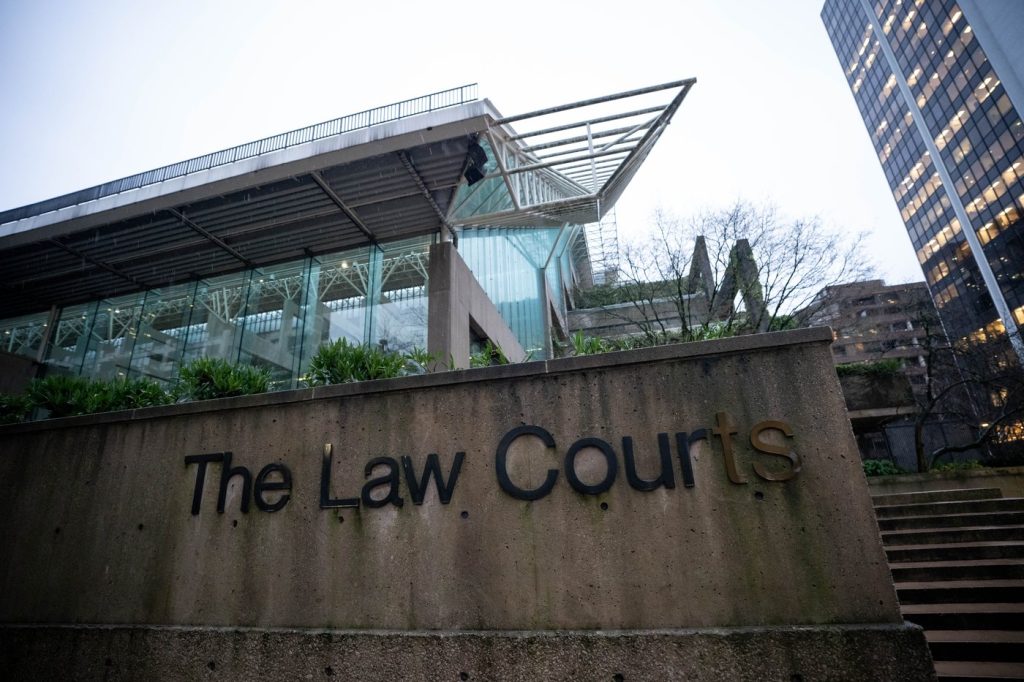
“It really makes no sense for cases to take as long as they do to come before the court for the first time. Once the court is before the court, there are checks and balances in place. Everybody has heard of a case called the Jordan’s [Decision,] which means a case has to come to trial within 18 months at the provincial court [level] or 30 months at the Supreme Court, and that’s a post-charge delay issue.”
Crown Counsel tells CityNews its no charge rate is at 19 per cent for the 2021/22 fiscal year. That’s a slight dip from 21.5 per cent in 2020-21 but about 10 per cent higher than it was just a decade ago.
“It is helpful to understand the charge assessment process. Each report to Crown Counsel received by police must be assessed on its own merits based on our charge assessment standard. The Crown Counsel Act authorizes each Crown Counsel in British Columbia to ‘examine all relevant information and documents and, following the examination, to approve for prosecution any offence or offences that he or she considers appropriate,'” it said.
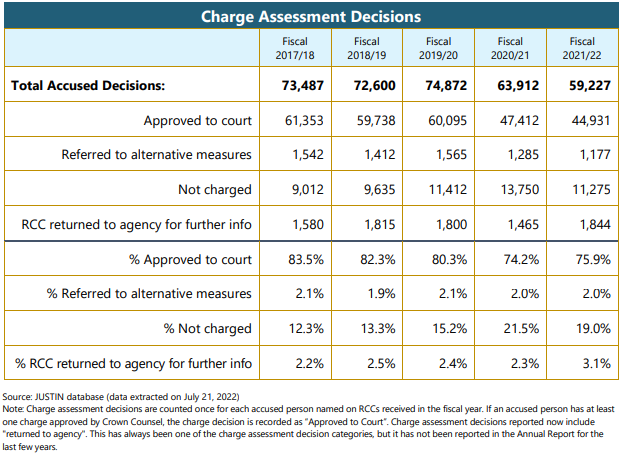
Crown says the charge assessment standard faces a two-part test: whether there is a substantial likelihood of conviction and if so, whether the public interest requires a prosecution.
“The reference to ‘likelihood’ requires, at a minimum, that a conviction according to law is more likely than an acquittal. In this context, ‘substantial’ refers not only to the probability of conviction but also to the objective strength or solidity of the evidence. A substantial likelihood of conviction exists if Crown Counsel is satisfied there is a strong and solid case of substance to present to the court.”
The Crown’s annual report can be found here.
CityNews reached out to the offices of both Federal Public Safety Minister Marco Mendicino and B.C.’s Premier-elect David Eby for comment on this story.